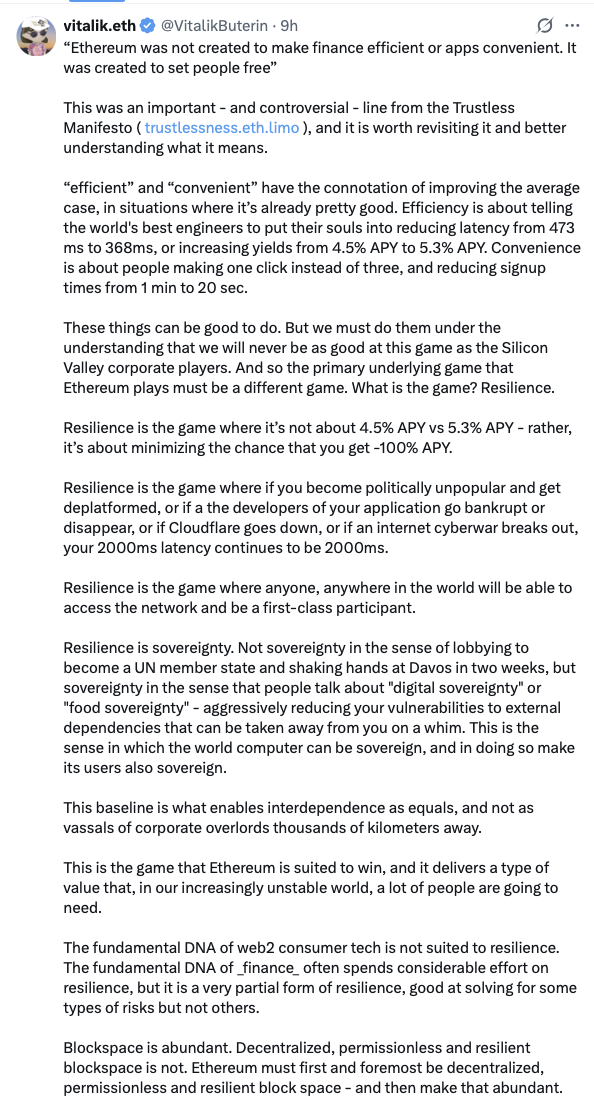
https://x.com/VitalikButerin/status/2008174642066845778?s=20
“이더리움은 금융이나 앱을 효율적으로 만들기 위해 만들어진 것이 아니다. 사람들을 자유롭게 하기 위해 만들어졌다.”
이 문장은 Trustless Manifesto(trustlessness.eth.limo)의 중요한, 그리고 논쟁적인 구절이었고, 그 의미를 다시 살펴보는 것은 가치가 있다.
“효율적(efficient)”과 “편리한(convenient)”이라는 말은, 이미 꽤 괜찮은 상황에서 평균적인 경우를 더 좋게 만든다는 뉘앙스를 가진다. 효율성은 전 세계 최고의 엔지니어들에게, 예를 들어 지연 시간을 473ms에서 368ms로 줄이거나, 이자를 연 4.5% APY에서 5.3% APY로 높이는 데 영혼을 갈아 넣으라고 요구하는 것이다. 편리함은 사람들이 세 번 클릭하던 것을 한 번만 클릭하게 만들고, 설정 시간을 1분에서 20초로 줄이는 것이다.
이런 것들은 좋은 일이 될 수 있다. 하지만 우리는 실리콘밸리 기업 개발자들이 뛰고 있는 게임과 같은 게임에서 결코 이길 수 없다는 이해를 전제로 두어야 한다. 그렇다면 이더리움의 근본적인 게임은 무엇인가? 게임의 이름은 회복탄력성(resilience)이다.
회복탄력성의 게임에서는 연 4.5% APY냐 5.3% APY냐가 중요하지 않다. 중요한 것은 -100% APY를 맞을 가능성을 얼마나 줄이느냐다.
회복탄력성의 게임에서는, 당신이 정치적으로 인기가 없게 되거나 체포되더라도, 당신이 사용하는 애플리케이션 개발자가 파산하거나 사라지더라도, Cloudflare가 다운되더라도, 인터넷 사이버 전쟁이 벌어지더라도, 평소 2000ms이던 지연 시간이 계속 2000ms로 유지되는지가 관건이다.
회복탄력성의 게임은, 세계 어디에 있는 누구나 네트워크에 접속할 수 있고, 1등 시민으로 참여할 수 있는 게임이다.
회복탄력성은 주권이다. 여기서 말하는 주권은 2주 안에 UN 회원국이 되기 위해 로비하고 다보스에서 회의석상에 서는 의미의 주권이 아니다. 사람들이 “디지털 주권”이나 “식량 주권”을 말할 때 쓰는 그 의미의 주권이다. 즉 외부 의존성을 공격적으로 줄여서, 마음만 먹으면 언제든 빼앗길 수 있는 것들을 줄이는 것이다. 이런 의미에서 세계 컴퓨터는 주권을 가질 수 있고, 그렇게 함으로써 사용자들 또한 주권을 갖게 한다.
이러한 기준선 위에서만 서로를 수천 킬로미터 떨어진 기업 군주들의 속국이 아닌, 동등하게 상호 의존하는 존재로 만들 수 있다.
이것이 이더리움이 승리할 수 있도록 설계된 게임이며, 점점 더 불안정해지는 이 세계에서 많은 사람들이 필요로 하게 될 종류의 가치를 제공하는 방식이다.
웹2 소비자 기술의 근본적인 DNA는 회복탄력성에 맞춰져 있지 않다. _finance_의 근본적인 DNA는 종종 회복탄력성에 상당한 노력을 들이지만, 일부 유형의 위험은 해결하면서 다른 위험 유형은 전혀 해결하지 못하는, 매우 부분적인 형태의 회복탄력성에 그치는 경우가 많다.
블록 공간(blockspace)은 풍부하다. 탈중앙화되고, 허가가 필요 없으며, 회복탄력적인 블록 공간은 존재한다. 이더리움은 먼저 그러한 탈중앙화되고, 허가가 필요 없으며, 회복탄력적인 블록 공간이 되는 것부터 하고, 그 이후에야 그 위에 무언가를 구축해야 한다.
<원문>
“Ethereum was not created to make finance efficient or apps convenient. It was created to set people free”
This was an important - and controversial - line from the Trustless Manifesto ( https://trustlessness.eth.limo ), and it is worth revisiting it and better understanding what it means.
“efficient” and “convenient” have the connotation of improving the average case, in situations where it’s already pretty good. Efficiency is about telling the world's best engineers to put their souls into reducing latency from 473 ms to 368ms, or increasing yields from 4.5% APY to 5.3% APY. Convenience is about people making one click instead of three, and reducing signup times from 1 min to 20 sec.
These things can be good to do. But we must do them under the understanding that we will never be as good at this game as the Silicon Valley corporate players. And so the primary underlying game that Ethereum plays must be a different game. What is the game? Resilience.
Resilience is the game where it’s not about 4.5% APY vs 5.3% APY - rather, it’s about minimizing the chance that you get -100% APY.
Resilience is the game where if you become politically unpopular and get deplatformed, or if a the developers of your application go bankrupt or disappear, or if Cloudflare goes down, or if an internet cyberwar breaks out, your 2000ms latency continues to be 2000ms.
Resilience is the game where anyone, anywhere in the world will be able to access the network and be a first-class participant.
Resilience is sovereignty. Not sovereignty in the sense of lobbying to become a UN member state and shaking hands at Davos in two weeks, but sovereignty in the sense that people talk about "digital sovereignty" or "food sovereignty" - aggressively reducing your vulnerabilities to external dependencies that can be taken away from you on a whim. This is the sense in which the world computer can be sovereign, and in doing so make its users also sovereign.
This baseline is what enables interdependence as equals, and not as vassals of corporate overlords thousands of kilometers away.
This is the game that Ethereum is suited to win, and it delivers a type of value that, in our increasingly unstable world, a lot of people are going to need.
The fundamental DNA of web2 consumer tech is not suited to resilience. The fundamental DNA of _finance_ often spends considerable effort on resilience, but it is a very partial form of resilience, good at solving for some types of risks but not others.
Blockspace is abundant. Decentralized, permissionless and resilient blockspace is not. Ethereum must first and foremost be decentralized, permissionless and resilient block space - and then make that abundant.